Is AI Your Child’s Therapist? Understanding the Pros and Cons of Artificial Intelligence in Mental Health

Artificial intelligence (AI) has changed the way we complete everyday tasks.  

From writing emails to generating graphics, AI has made many parts of daily life faster and easier. But as this technology becomes more common, it has raised important questions about how and when it should be used—especially in mental health.  

Should people turn to AI when they’re facing a problem? Is it healthy to bring AI into such personal and emotional spaces?  

While we can’t answer these questions outright, we can look at the pros and cons of AI chatbots in mental health. For families, understanding both sides can help set healthy boundaries around technology use and guide children towards the right support for their mental well-being.  

How does AI Work? 

When a user types a question or a message into a chatbot, it uses natural language processing (NLP) technologies to understand human language and analyze the input and the user’s intent. Once it processes these, the chatbot will generate an adequate response. 

AI chatbots also use machine learning (ML) to create a deeper understanding of the user’s requests and be able to generate better recommendations based on what it has been fed. These features are designed to keep users coming back, since they’ll know the chatbot “knows” them and their personal history. 

However, these technologies carry a big caveat: they tend to overly agree with users—even when they’re wrong. In a study published in Science,  researchers found that even when describing dangerous behaviors, chatbots would agree and affirm them, raising concerns for the wellbeing of users and the future of interpersonal relationships. 

While chatbots aren’t programmed with the intention to encourage negative actions, it is important to understand how and why it can escalate certain situations. 

The Pros of Using AI for Mental Health 

It’s helpful to start by looking at where AI may offer support when used carefully and alongside professional care. 


  • Quicker, more efficient diagnoses: AI can help mental health professionals diagnose conditions at an earlier stage. By analyzing large sets of patient data, these systems can help generate reports that support clinical decision-making for parents and guide treatment planning for children and teens in a more efficient manner.  


  • Accessibility: When people are facing a mental health crisis, long wait times and unavailable professionals can make it hard to get the care quickly. AI-powered chatbots may provide a place to organize thoughts, share feelings, and receive general feedback while they works towards getting professional support. This is especially appealing to children and teens, since they don’t have to go through a parent to find support. They can just access it themselves.  


  • Affordability: High costs of care and lack of in-network providers can also keep people from getting support. Because many AI chatbots are free or less expensive than an out-of-pocket therapy appointment, some people may use them to talk through what they are feeling and ask questions about the kind of help they may need. Groups like teens, and young adults who don’t have a lot of money or depend on parents to pay for mental health treatment benefit from these services, as they don’t have to feel the financial burden of their condition thanks to AI sites. 

The Cons of Using AI for Mental Health 

While AI offers some support, it’s just as important to understand the risks—especially for children and teens, who may be more impressionable and still learning how to process difficult emotions.  

  • It may reinforce negative behaviors: Validation can feel helpful, but AI may offer supportive feedback even when a user needs to reflect their own role in a situation. For example, if a teen yells at their partner and then describes the conflict to a chatbot, the response is most likely to focus on validating their feelings instead of helping them take accountability. AI sites are not meant to argue with users; their programming is to validate your experiences and ideas unless otherwise prompted. This can keep users – especially impressionable children and young adults – from forming the sense of accountability needed to create strong relationships. Over time, this could make it harder for a teen to recognize harmful patterns, repair relationships, and learn healthier ways to communicate.  


  • Stigma regarding certain conditions: Recent studies have shown that some therapy bots may respond differently when users describe symptoms connected to conditions such as alcohol dependency or schizophrenia. If these tools reinforce stigma or bias, they could make children and teens feel less understood and discourage them from seeking the help they need.  


How to Deal with AI as a Parent 

  • Discuss the pros and cons mentioned above with your children: be honest about the pros and cons about using these sites. Emphasize the risks that worry you the most– especially if you have older children or teens—but frame these as a possible starting point to answer questions about mental health. Like with any other tool, if your children have a better understanding of it, they can use it more appropriately. Spend time teaching them how to use AI chatbots safely, —what not to ask it, what information to keep private, etc.—how to write appropriate prompts, and how to push back against AI when its recommendations sound inadequate or out of place. 


  • Limit time spent on AI chatbots and sites: Platforms like ChatGPT and Gemini have parental controls you can implement to limit excessive use.   


  • (For younger children) Be present when they use AI sites: Teach your children to ask for permission when they want to consult or ask something using an AI site. In case they receive an answer that’s not appropriate or concerning, you can talk to them about it right then and there.  

Conclusion 

Even though AI can help you vent and navigate your feelings when you’re struggling, it can’t help you identify negative behavioral patterns or teach you how to correct your thinking patterns. That’s where a licensed mental health professional comes in.   

AI can listen to your child, but a therapist can help them understand why they feel the way they do and guide them to take steps to feel better. Using AI to vent is a starting point—not the end. If your child is struggling with mental health, you can count on our team of experts to help your family during these times. 

You can schedule an appointment on our site or give us a call at 954-764-7337 to get started.  


Sources 

https://americanbehavioralclinics.com/ai-and-mental-health-benefits-risks-and-how-professionals-can-help/ 

https://activeminds.org/blog/exploring-the-pros-and-cons-of-ai-in-mental-health-care/ 

https://hai.stanford.edu/news/exploring-the-dangers-of-ai-in-mental-health-care 

https://boost.ai/learn/chatbot/how-do-chatbots-work/ 

https://news.stanford.edu/stories/2026/03/ai-advice-sycophantic-models-research 

 

Signs of a toxic relationship and what to do about it

No relationship is perfect. Even if you get along just fine with your friends, relatives, and partner, there will always be ups and downs. However, you probably know of some relationships that seem negative and unbalanced in the way one individual treats the other. Maybe you’ve experienced something like this yourself, where instead of lifting you up, someone you know goes out of their way to bring you down. 

Maybe a friend always makes backhanded compliments, or maybe a parent continually blames you for things out of your control. Maybe a romantic partner constantly criticizes or belittles your opinions, choices, or appearance. 

These types of behaviors are more than annoying personality quirks: they’re red flags that you’re in a toxic relationship.  

What is a “toxic relationship”? 

Charlie Health defines a toxic relationship as “any relationship that is damaging to your mental health, self-esteem, and overall well-being,” and it can apply to friends, family, romantic partners, or other people you know.  

Toxic relationships are often characterized by lack of boundaries, manipulation, and constant stress on the receiving party. 

Are toxic relationships the same as abusive relationships? 

No. All abusive relationships are toxic relationships, but not all toxic relationships are abusive. A toxic relationship is characterized by a lack of respect and boundaries. Sometimes these behaviors might be unintentional, if the person truly doesn’t realize what they’re doing and how it’s making you feel. 

However, if they don’t change their behavior after you let them know how it’s affecting you, and if they continue to try to belittle, harm, or control you, then you might be looking at an abusive relationship.  

Sometimes the problem is too difficult to handle yourself. If you need more specialized help, the National Domestic Violence Hotline can help you. Call 1-800-799-7233 or text START to 88788.  

What are some signs of toxic behavior? 

Although toxic relationships can manifest in multiple ways, here are some of the main tell-tale signs that you’re in an unhealthy situation.  

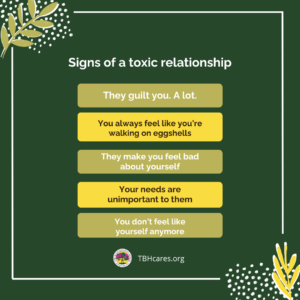
  • They guilt you. A lot. Whenever you can’t or aren’t interested in doing something they want to do, the person immediately starts saying things intended to make you feel ungrateful, uncooperative, inconsiderate, or a bad person in general.  


  • You always feel like you’re walking on eggshells: if you always find yourself having to be careful about what you say and how you say it because this person often reacts badly, it’s a sign that you’re not in a healthy situation. Relationships should be a safe and open space, not a reason for anxiety, and you shouldn’t have to be guarded about every little thing you say. 


  • They make you feel bad about yourself: does your friend constantly make you feel embarrassed about the outfits you wear? Does a parent make you feel like you’re not smart enough (“Only a B+?”) or compare you unfavorably to your sibling? Although the comments themselves may only be small digs, they add up over time, they sting, and they create an unhealthy dynamic that erodes your self-esteem.  


  • Your needs are unimportant: you often feel like you’re doing all you can to meet the other person’s wants and needs, but you don’t see the same in return. In fact, when you bring up how you feel or what you want to see from them, you’re often ignored or dismissed. It can be something small like wanting an occasional compliment from your partner or asking your friend to sometimes consider your wishes when deciding on social plans.  


  • You don’t feel like yourself anymore: you spend so much time doing what the other person wants in order to please them that you stop thinking about what you want. Lately, it seems like you only go to the places they like, with the people they like, and do things they like. When you try to switch it up to something you want to do, they get frustrated or angry and either refuse, or go unwillingly and then make you, themselves, and everyone around them miserable. 

How can I navigate a toxic relationship? 

  • Recognize the need for change: acknowledge that this relationship is currently not healthy, and that you deserve to see a change.  
  • Communicate and set clear boundaries: talk to the other person and express how you’re feeling. Let them know what you expect from them in the future, and clearly define what’s unacceptable for you.  
  • Cut off contact, if necessary and possible: So you’ve talked to the person, but nothing has changed. Maybe it’s time to consider cutting off this relationship, if it’s possible. Here are more specific tips for different relationships: 
  • Friendships: You can either have a candid conversation with your friend, stating your feelings and your desire to end the relationship, or you can gradually cut contact, including on social media. It’ll depend on what you feel is best for the situation.  
  • Romantic relationship: if it’s safe to do so, and if you feel ready to follow through, have the same kind of tough conversation and plainly state your desire to end the relationship. If you can, make a clean break and don’t let yourself be drawn into “can we talk about it” or “let’s make this work” or “I’ll do better” conversations.  
  • In both of these situations, there may be drama, and others may choose sides and try to get involved, but your true friends will stand by you.  
  • Parents: we understand it is harder to cut a parent out of your life, especially if  you still live with them. First,  understand you have a right to be respected. It isn’t okay for parents to criticize, belittle, or embarrass you, just because you’re their child.  You also have a right to prioritize your own needs without being guilt-tripped. Once you understand this, start thinking of what boundaries to set. For example, tell them you want to be alone from 7-8 PM because that’s your time to do homework, or let them know your social life is not a topic you want to discuss. If you try to do this respectfully and they still invade your peace, we recommend using an exit strategy: be ready to walk out of the situation, whether means leaving the room or stepping out of the house for a while to meet with a supportive friend.    
  • Other family members: if you have an overly critical grandparent, or an aunt who’s inconsiderate of your feelings, try to avoid interactions. Unless it’s special occasions like holidays or birthdays, reduce contact with them to protect yourself. If a parent tries to push you to talk to them, explain why you don’t feel comfortable doing so. If you’re in the same room and they’re steering the conversation towards your personal life, deflect them (kindly) by saying something along the lines of “I don’t feel comfortable discussing this. Could we talk about something else?”. For more advice on dealing with extended family, especially during holidays, you can read this blog entry. 
  •  Seek support: talk to other friends and family about your situation, and if possible, reach out to a professional who can guide you through this complicated transition.   


    As we said earlier, it is normal to have rough patches with the people in our lives: sometimes we might argue, sometimes we might say something we don’t mean…but when these behaviors are the norm and not the exception, it’s time for you to reflect on whether this is a relationship that’s healthy or beneficial for you. Please remember that nothing positive comes from someone dismissing or belittling you, guilting you, or shaming you, then claim they’re doing it for your good. That person is trying to build themselves up by tearing you down, but no healthy relationship is ever built on communication patterns like that. 


    Need more help? 

    Here at The Bougainvilla House, we’ll provide you with safe and compassionate care as you take the necessary steps to navigate and leave these unhealthy relationships. To start your healing journey, call us at (954)-764-7337.